For just a brief moment, a traveler from another star passed through our skies—leaving behind stunning clues about how alien worlds might form. Thanks to a new series of crisp images taken by specialized spacecraft, astronomers have captured a rare interstellar comet in unprecedented detail. Let’s dive into the story of 3I ATLAS and what makes it so enthralling.
A Rare Visitor from Beyond Our Solar System
Comet 3I ATLAS isn’t your average sky-gazer. It’s only the third known interstellar comet—objects that come from outside our solar system and never return. Before it, only 1I ‘Oumuamua (2017) and 2I/Borisov (2019) earned that title. These comets travel on hyperbolic orbits, which means they’re not bound to our Sun’s gravity.
3I ATLAS whipped past our Sun and is now speeding back into deep space, never to return. But while it was here—astronomers seized the chance to watch, measure, and learn.
How the Spacecraft Captured the Images
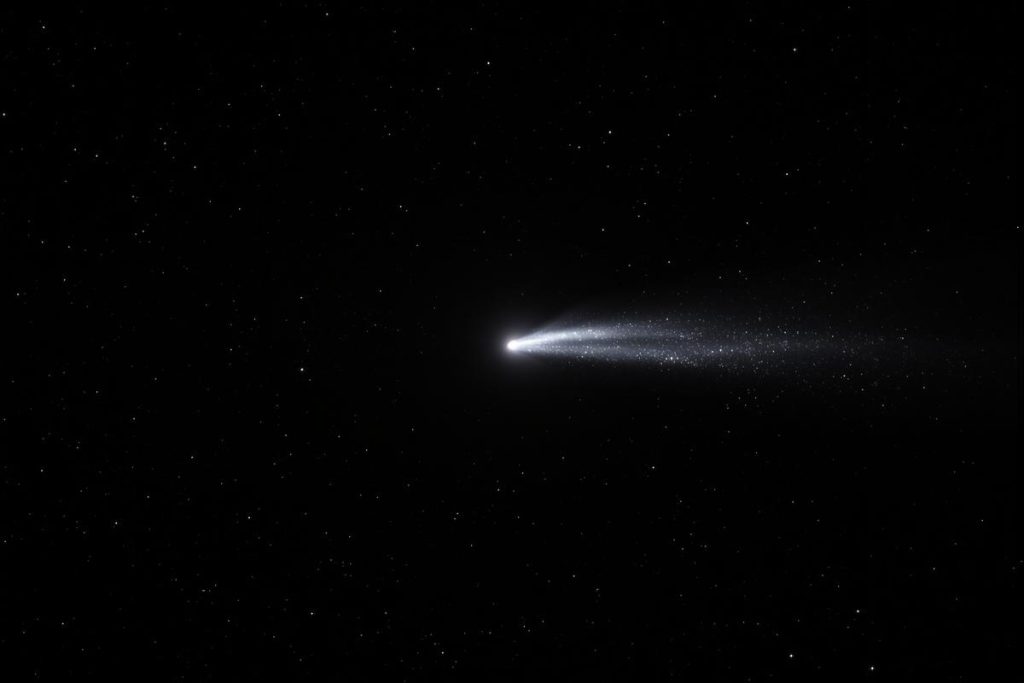
This unique eight-frame image sequence didn’t come from space telescopes. Instead, it came from spacecraft tools that usually monitor the Sun. These instruments captured 3I ATLAS as a moving streak of light during its flyby.
The images reveal:
- Jets of gas and dust fanning out from the comet
- Changes in shape and brightness as it reacted to sunlight
- Shifting tails that twist and fade with solar pressure
By stacking the photos, scientists could track the comet’s movement and study how it changed over time. Like a time-lapse documentary, each photo added a piece to the puzzle.
What Makes 3I ATLAS So Intriguing
Because it formed around another star, 3I ATLAS is like a frozen message from an alien world. It may have been kicked out of its home system during chaotic planet formation. Now, it passes through ours—offering a glimpse at what other planetary nurseries are like.
From these images, astronomers learned:
- The rate of dust and gas ejection as it neared the Sun
- The size and structure of its coma, or glowing halo
- Variations in brightness that suggest fragmentation or spin
- The color of reflected light, giving clues about its icy composition
Interestingly, 3I ATLAS behaves a lot like our own system’s comets. It brightens in similar ways and sheds material at rates that align with known models. This suggests that icy building blocks for planets might be more common across the galaxy than we once thought.
What the Comet Tells Us About Alien Systems
Comets like 3I ATLAS trap ancient material from their birthplaces. As they near the Sun, some of it evaporates—giving us a chance to analyze it.
Scientists looked for key molecules like:
- Water vapor
- Carbon monoxide and dioxide
- Organic compounds made of carbon and hydrogen
Comparing these chemicals with those in our own comets helps determine how similar (or different) distant planetary systems are. So far, 3I ATLAS shows a mix of both familiar and slightly unusual chemical ratios.
Why the Eight-Image Set Is So Important
While big telescope campaigns grab headlines, this image series delivers something more: consistency. Each snapshot was taken at regular intervals. That’s perfect for spotting short-lived events like bursts of gas or tiny changes in brightness.
Scientists used these images to:
- Track gas flows over time
- Test if the nucleus is solid or fractured
- Look for signs of spinning or tumbling
If one side of the coma expands more, it suggests an active vent on that area. If it happens regularly, the comet might be rotating. All of these details help refine computer models of how comets behave.
Is There Any Danger to Earth?
Good news—3I ATLAS posed no threat. It passed safely through the solar system and was far too small to cause a major impact. It left behind some dust, but it’s unlikely to cause meteor showers on Earth. The geometry just isn’t right.
Now that it’s leaving, it’ll drift through the galaxy for millions of years. Surface radiation will slowly wear it down, but its icy core may stay frozen, like a core sample from another star system locked in time.
How 3I ATLAS Adds to the Bigger Picture
Each interstellar visitor rewrites part of the cosmic story. Remember:
- 1I ‘Oumuamua was dry and oddly shaped
- 2I/Borisov looked and acted like a classic comet
- 3I ATLAS shows a blend of both, caught in sharp detail
These objects may be more common than we once believed. They likely form when planets shift and fling out debris during early solar system growth. Some dust gets thrown out at escape speed—wandering between stars for billions of years.
What Comes Next?
Future telescopes with wider views and faster cameras will catch more interstellar visitors. And space agencies are already testing ideas for quick space probes that can chase them down before they vanish. Some concepts include solar sails or small riders dropped off larger spacecraft.
Meanwhile, simulations are running nonstop. Researchers adjust star systems, move virtual planets, and see which setups produce ejected comets with paths like 3I ATLAS’s. It’s like solving a mystery in reverse—tracking the comet back to a type of star system it may have come from.
Final Thoughts
Comets like 3I ATLAS remind us how vast and connected the galaxy truly is. With just eight photographs, scientists have unlocked an interstellar object’s secrets—touching the early conditions of another solar system. And as more of these travelers appear, we get closer to understanding the building blocks that make planets—and maybe even life—across the Milky Way.